Last updated: August 2026
Information checked: August 2026
Getting sick in a country where you do not speak the language can feel much more stressful than the illness itself.
The good news is that getting medical care in Busan is usually manageable even if your Korean is limited.
For common illnesses, you can usually start with a neighborhood clinic. Larger general hospitals are available throughout Busan, and some medical institutions provide interpretation or international-patient services. If language support is important, however, it is always better to call before visiting rather than assuming an English-speaking doctor will be available. Busan’s official medical guidance also recommends checking availability before visiting a medical institution.
If it is an emergency, call 119.
This guide explains how to find an English speaking doctor in Busan, what type of clinic to choose, what to bring, how prescriptions work, and what to do if you need medical care at night or during an emergency.
Quick Answer: Can You See a Doctor in Busan Without Speaking Korean?
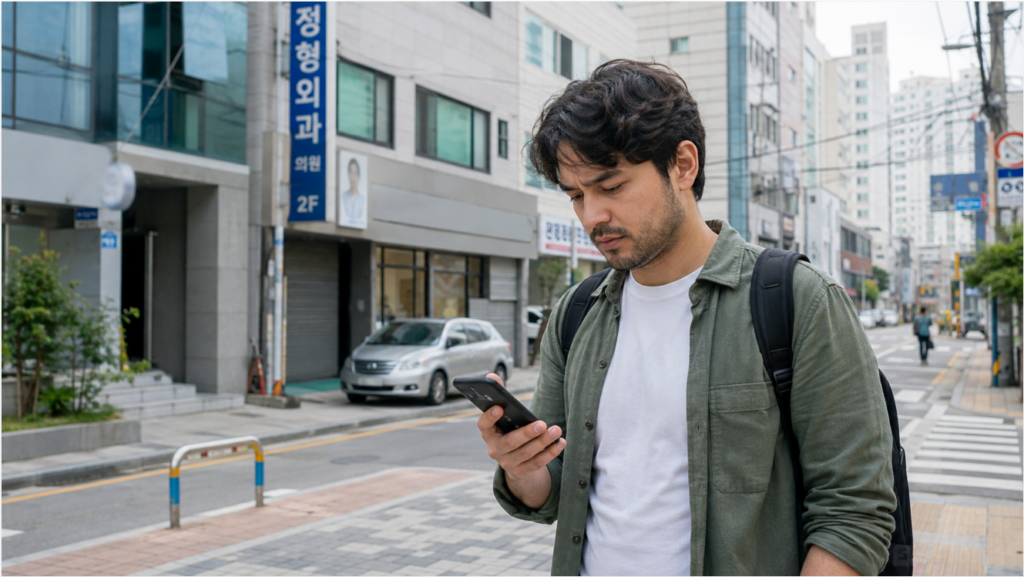
Yes.
For most everyday medical problems, the process is:
- Find the right type of clinic.
- Call ahead if you need English support.
- Bring your identification and health insurance information.
- Register at reception.
- See the doctor.
- Pay at the clinic.
- Take your prescription to a pharmacy if medication is prescribed.
Foreign residents enrolled in Korea’s National Health Insurance receive health insurance coverage under the same general benefit framework as Korean citizens. The amount you personally pay depends on the medical service and type of medical institution.
You do not always need a large hospital.
For a cold, stomach problem, minor skin condition, ear problem, or similar everyday issue, a local clinic is often the simplest place to start.
1. First, Choose the Right Type of Clinic
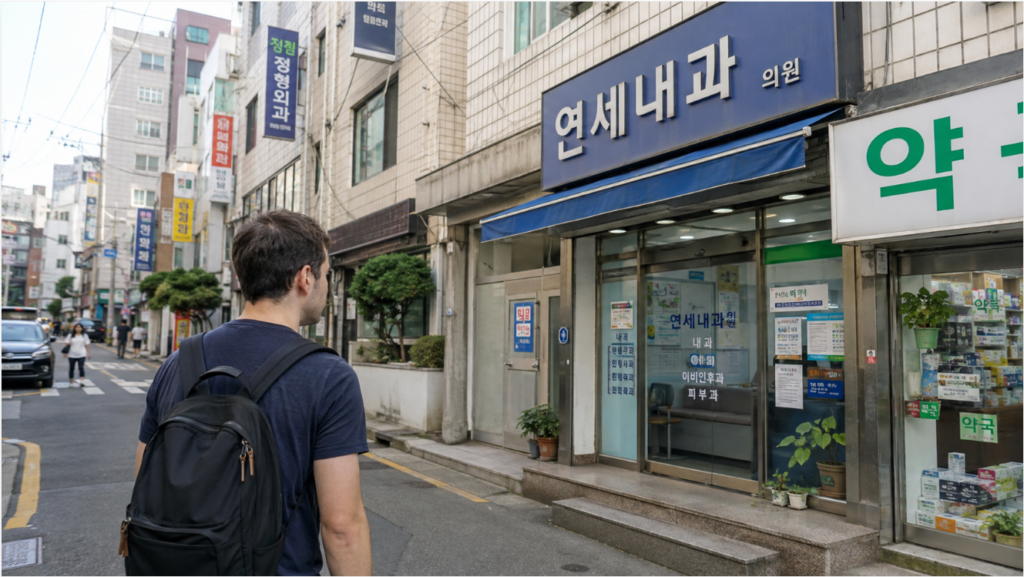
One of the confusing parts of Korean healthcare is that many neighborhood clinics specialize in a particular area.
Instead of searching only for “hospital,” look for the specialty that matches your problem.
Here are some Korean signs worth recognizing:
| Korean | English | Common reason to visit |
|---|---|---|
| 내과 | Internal Medicine | Cold, fever, stomach problems, general adult illness |
| 이비인후과 | ENT | Ear, nose, throat, sinus problems |
| 피부과 | Dermatology | Skin problems |
| 정형외과 | Orthopedics | Bones, joints, sprains, back pain |
| 안과 | Ophthalmology | Eyes |
| 산부인과 | Obstetrics & Gynecology | Women’s health |
| 소아청소년과 | Pediatrics | Children |
| 치과 | Dental clinic | Teeth and gums |
| 정신건강의학과 | Psychiatry | Mental health |
| 비뇨의학과 | Urology | Urinary and related conditions |
If you have a simple sore throat, for example, searching for:
이비인후과
on a Korean map app may produce much better local results than searching for “English hospital.”
For general adult symptoms, 내과 is often a practical starting point.
2. How to Find an English-Speaking Doctor in Busan
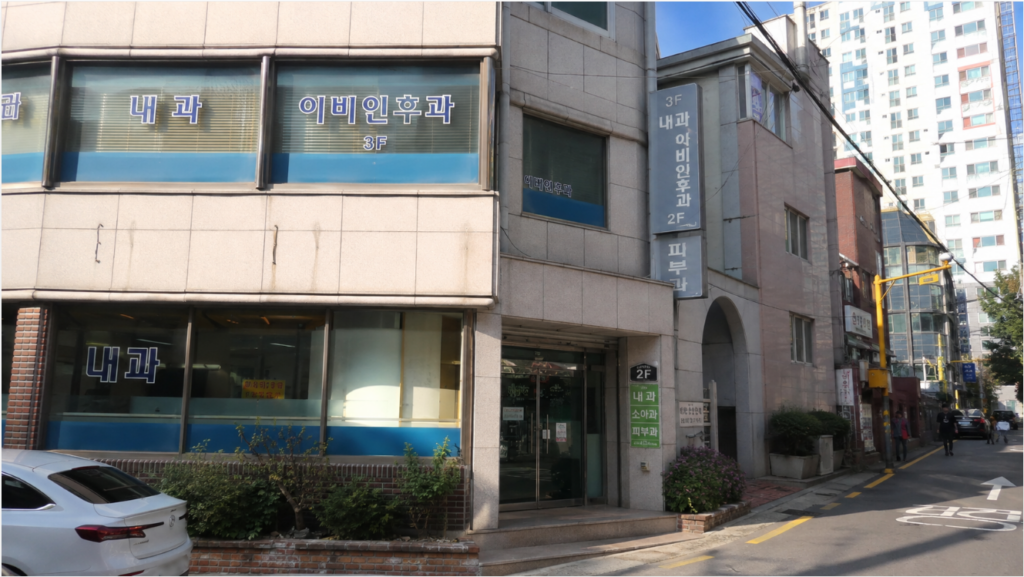
There is no guarantee that every neighborhood clinic will have an English-speaking doctor or receptionist.
The safest method is to check before you go.
Search the clinic on NAVER Map or another map service and call with a simple question:
영어 진료 가능하세요?
Yeongeo jinryo ganeunghaseyo?
“Is medical consultation in English available?”
You can also ask:
영어 가능한 의사 선생님 계세요?
“Is there a doctor who speaks English?”
Even when the doctor speaks some English, reception staff may not.
That matters because much of the administrative part of the visit happens before you meet the doctor.
If you cannot confirm language support, prepare your symptoms in writing on your phone.
For example:
Fever since yesterday
Temperature: 38.2°C
Sore throat
No known drug allergies
Current medication: _____
Showing clear information can be much easier than trying to explain everything verbally.
3. You Usually Do Not Need a University Hospital for a Minor Problem
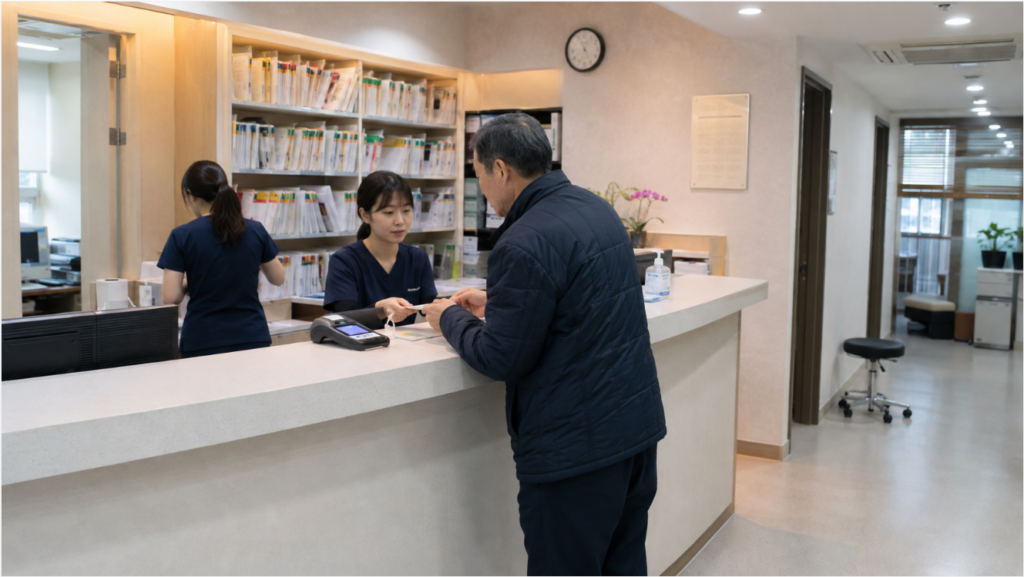
Korea’s healthcare system includes clinics, hospitals, general hospitals, and tertiary hospitals.
For everyday health problems, starting with a nearby clinic is usually much simpler.
Large hospitals are more appropriate when you need specialist treatment, advanced testing, emergency care, surgery, or care that cannot reasonably be handled by a local clinic.
Busan Metropolitan City maintains an official English-language list of general hospitals throughout the city, including institutions in Haeundae, Suyeong, Dongnae, Busanjin, Nam-gu, Yeonje and other districts.
That means you do not necessarily need to travel across Busan simply because you need a hospital.
Start by checking what is available near your neighborhood.
https://www.busan.go.kr/eng/bsmedical04?utm_source=chatgpt.com
4. What Should You Bring to a Clinic?
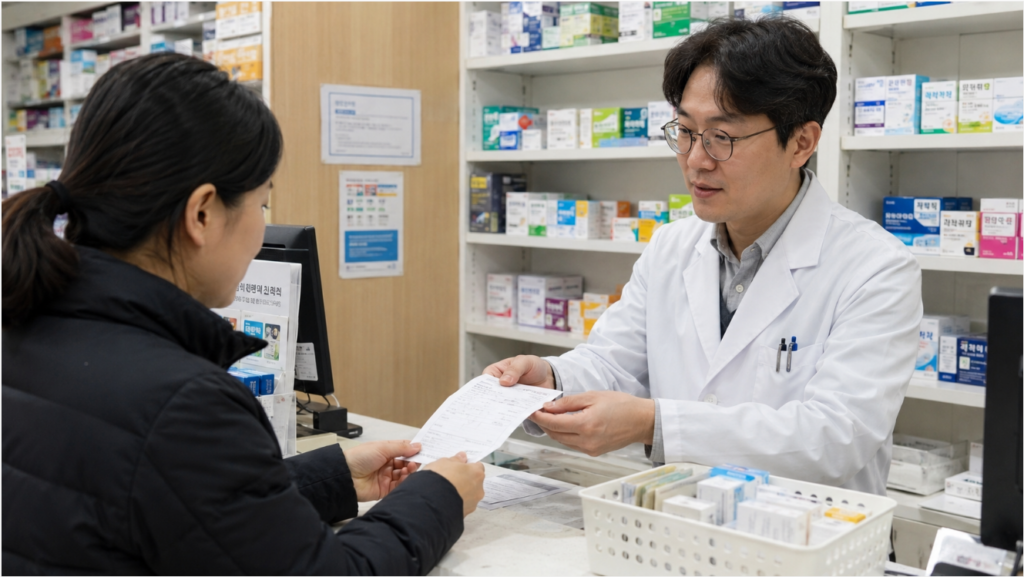
For a normal medical visit, keep these with you:
- passport or foreign residence card
- National Health Insurance information if you are enrolled
- Korean phone number
- payment card or cash
- list of medications you currently take
- information about allergies
- previous medical records if relevant
If you have medication from your home country, take a photo of the packaging.
Do not rely only on the brand name.
The same medication may be sold under a different brand in Korea, so showing the active ingredient can be more useful.
If you have a complicated medical history, prepare a short summary before your appointment.
5. What Happens When You Visit a Korean Clinic?
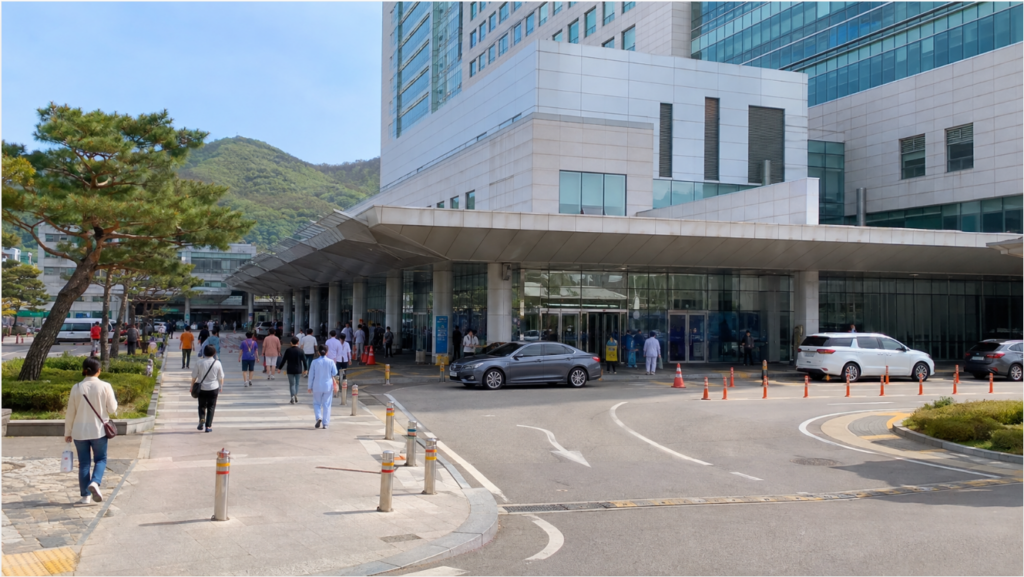
The process is usually straightforward.
Step 1: Go to reception
When entering the clinic, look for:
접수
This means registration or reception.
Tell the receptionist that you want to see the doctor.
If it is your first visit, you may need to provide identification and basic personal information.
Step 2: Wait for your name
Many small clinics do not use complicated appointment systems for routine visits.
You may register and wait until your name is called.
Some clinics accept advance reservations, so check before visiting if waiting time matters.
Step 3: See the doctor
Explain your symptoms.
If communication becomes difficult, use:
- a translation app
- written symptoms
- photos
- previous medical records
- medication names
Do not be embarrassed about using your phone during the consultation.
Clear communication is more important than perfect Korean.
Step 4: Pay at reception
After the consultation or treatment, return to reception.
You normally pay the clinic directly.
If you are covered by Korean National Health Insurance, the amount you personally pay depends on the medical service and institution. NHIS explains that patient co-payment rates differ according to the type and level of healthcare institution and whether treatment is inpatient or outpatient.
There is therefore no useful single answer to:
“How much does a doctor’s visit cost in Korea?”
The cost depends on what treatment you receive.
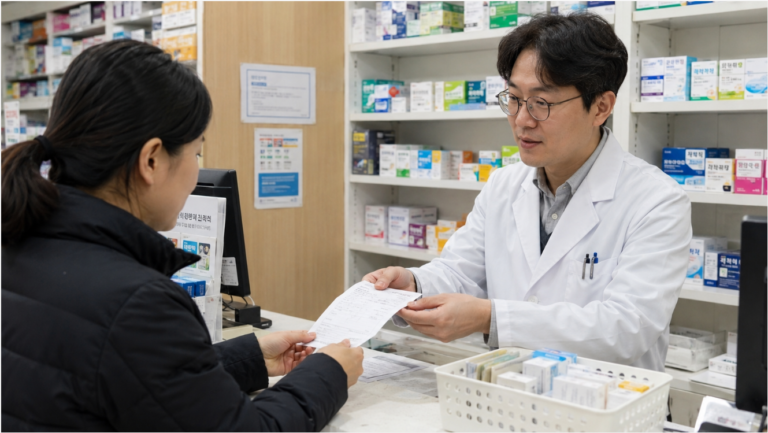
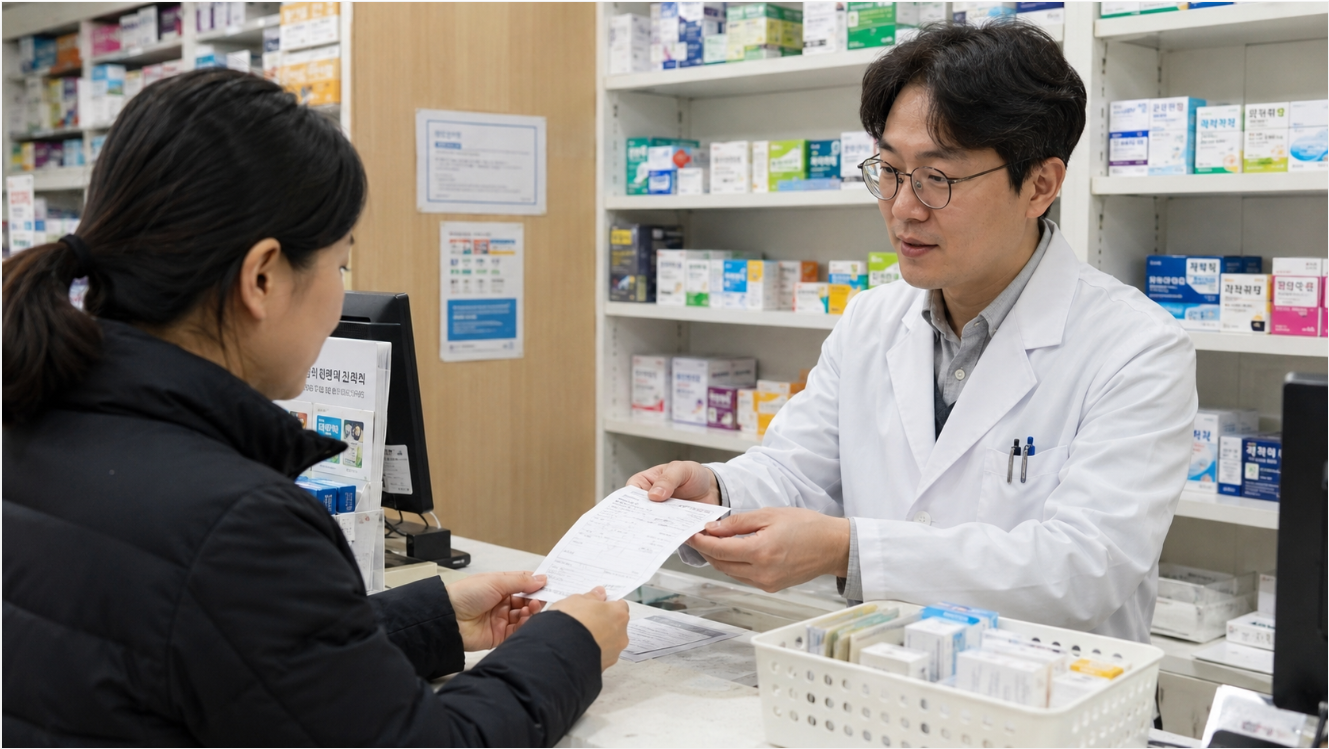
6. Prescriptions and Pharmacies Work Separately
A common surprise for newcomers is that receiving a prescription does not necessarily mean receiving medicine at the clinic.
After seeing the doctor, you may receive a prescription:
처방전
You then take it to a pharmacy:
약국
Pharmacies are extremely common in Korean neighborhoods, and you will often find several close to a clinic or hospital.
Give the prescription to the pharmacist.
The pharmacist will prepare your medication and explain how to take it.
Typical instructions may include:
하루 세 번 — three times a day
식후 — after meals
식전 — before meals
If you do not understand the instructions, ask the pharmacist to write them down or use image translation before leaving.
Do not guess medication dosage.
7. What If You Need a Pharmacy Late at Night?
Not every pharmacy stays open late.
Busan publishes information about late-night pharmacies in different districts. The city’s pharmacy page currently lists participating pharmacies in areas including Jung-gu, Busanjin-gu, Haeundae-gu, Nam-gu, Suyeong-gu, Dongnae and others, while advising residents to confirm operating hours before visiting.
This is particularly important on:
- Sundays
- public holidays
- late evenings
- Seollal
- Chuseok
Do not assume the pharmacy you normally use will be open.
Busan’s Emergency Medical Service Guide also provides information for finding operating hospitals, clinics and pharmacies.
https://www.busan.go.kr/eng/bsmedical06?utm_source=chatgpt.com
8. A Useful Option for International Students in Busan
International students have an additional Busan-specific option.
Busan has designated three hospitals to provide tailored medical support for international students:
- Good Gang-An Hospital in Suyeong-gu
- Dong-Eui Medical Center in Busanjin-gu
- Dae Dong Hospital in Dongnae-gu
According to Busan Metropolitan City’s 2026 guidance, these hospitals provide interpretation support in up to four languages, and international students may receive specific services or benefits by presenting a student ID.
If you are studying at a university in Busan, check whether your university also has arrangements with a nearby hospital or clinic.
Your international office may be able to help with:
- hospital recommendations
- interpretation
- insurance questions
- appointment assistance
This can be much easier than trying to solve everything independently.
9. How Korean National Health Insurance Affects Your Visit
Foreign residents do not all have the same insurance situation.
Some foreign employees enter National Health Insurance through their workplace, while other eligible foreign residents may become insured according to residence and eligibility rules.
NHIS states that foreigners who are enrolled receive the same insurance benefit framework as Korean citizens for covered healthcare services.
If you are not sure whether you are insured, do not guess.
Check your status with NHIS.
The National Health Insurance Service currently provides an English consultation line at:
033-811-2000
If you are uninsured, you may have to pay significantly more of the medical cost yourself.
Busan also operates a medical-care assistance program for certain foreign workers and other eligible people who are not covered by Korea’s health insurance system. Eligibility conditions apply.
10. What Should You Do in a Medical Emergency?
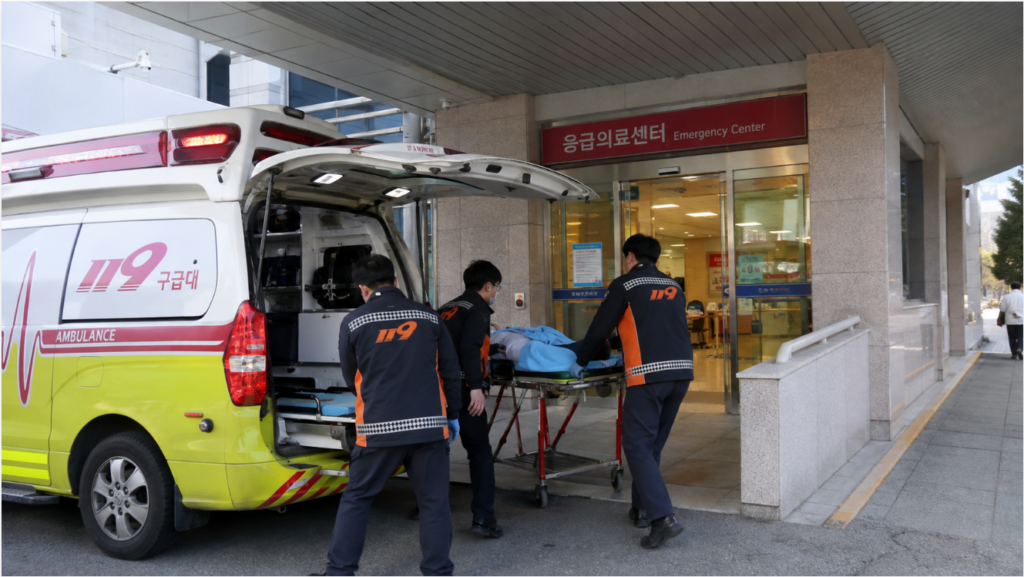
For a serious emergency, call:
119
You do not need an area code.
Busan states that 119 can be called directly from a mobile phone for emergency rescue services.
Busan’s current emergency medical guide also says that if you are unsure whether your symptoms require emergency care, you can call 119 for consultation.
Examples of situations that may require urgent emergency assistance include:
- difficulty breathing
- loss of consciousness
- severe injury
- uncontrolled bleeding
- sudden severe symptoms
Do not spend time searching for an English-speaking clinic during a serious emergency.
Call 119.
If possible, keep your Korean address saved on your phone so you can show or provide your exact location quickly.
https://www.busan.go.kr/eng/emergency-medical-service-guide?utm_source=chatgpt.com
11. Useful Korean Phrases at a Clinic
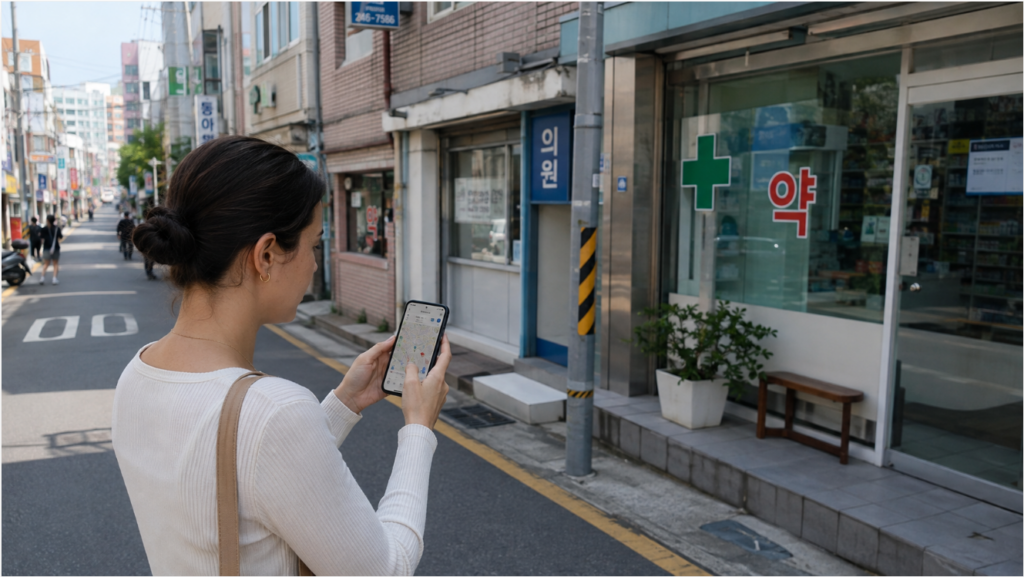
You do not need to speak fluent Korean to make a medical visit easier.
These phrases cover many basic situations.
“Is English available?”
영어 가능하세요?
Yeongeo ganeunghaseyo?
“I want to see a doctor.”
진료 받고 싶어요.
Jinryo batgo sipeoyo.
“It hurts here.”
여기가 아파요.
Yeogiga apayo.
Point to the location.
“I have a fever.”
열이 있어요.
Yeori isseoyo.
“I am allergic to this medicine.”
이 약에 알레르기가 있어요.
I yage allergy-ga isseoyo.
“How many times a day?”
하루에 몇 번 먹어요?
Harue myeot beon meogeoyo?
“Before or after meals?”
식전이에요, 식후예요?
Sikjeonieyo, sikhu-yeyo?
You will probably never use all of these at once.
Save the few that are useful to you.
12. Set Up Your Medical Backup Before You Get Sick
One of the easiest ways to make life in Busan less stressful is to prepare while you are healthy.
Open your map app and save:
- one nearby internal medicine clinic
- one pharmacy
- one late-night pharmacy
- one general hospital
- the closest emergency department
Then save:
119 — Emergency rescue
You may never need the emergency option.
But when you are sick, having these places already saved is much easier than searching from bed with a fever.
This is especially useful if you live alone.
Frequently Asked Questions
Can I find an English-speaking doctor in Busan?
Yes, English-language medical services are available in Busan, particularly at some larger hospitals and facilities serving foreign patients. However, language availability can depend on the doctor, department and time of visit, so call ahead before assuming English support is available.
Busan Metropolitan City provides an English list of general hospitals throughout the city.
Can I visit a Korean clinic without National Health Insurance?
You can receive medical treatment without being enrolled in Korean National Health Insurance, but you may need to pay more of the cost yourself.
If you are a foreign resident and do not know your insurance status, check directly with NHIS before you need treatment.
Do doctors in Korea speak English?
Some do, but it varies considerably.
Doctors in larger hospitals may have more experience treating international patients, while neighborhood clinics vary.
The safest option is to call and ask:
영어 진료 가능하세요?
Do I need an appointment for a clinic in Busan?
Many neighborhood clinics accept walk-in patients, while larger hospitals and particular specialists may use appointments.
Check the individual clinic before visiting.
Can a pharmacy give me prescription medicine without seeing a doctor?
Medicines that require a prescription need a valid prescription.
For everyday over-the-counter products, you can ask the pharmacist directly.
If you are unsure what type of medicine you need, describe your symptoms rather than trying to choose medication yourself.
What number should I call for a medical emergency in Busan?
Call 119.
Busan’s official emergency guidance lists 119 for emergency rescue, and the city’s Emergency Medical Service Guide also recommends calling 119 when you are unsure about urgent symptoms.
Final Thoughts
Finding an English speaking doctor in Busan becomes much easier once you understand how the local system works.
For an everyday illness, start with the right neighborhood clinic.
Call ahead if you need English.
Bring your identification and insurance information, prepare your symptoms on your phone, and remember that prescriptions are often filled separately at a pharmacy.
For something more serious, Busan has general hospitals throughout the city.
And in an emergency, do not worry about finding the perfect English-speaking hospital first.
Call 119.
The best preparation is simple: find a clinic, pharmacy and hospital near your home before you actually need them.
https://easykorealife.com/wp-admin
About the Author