Last updated: August 2026
Information checked: August 2026
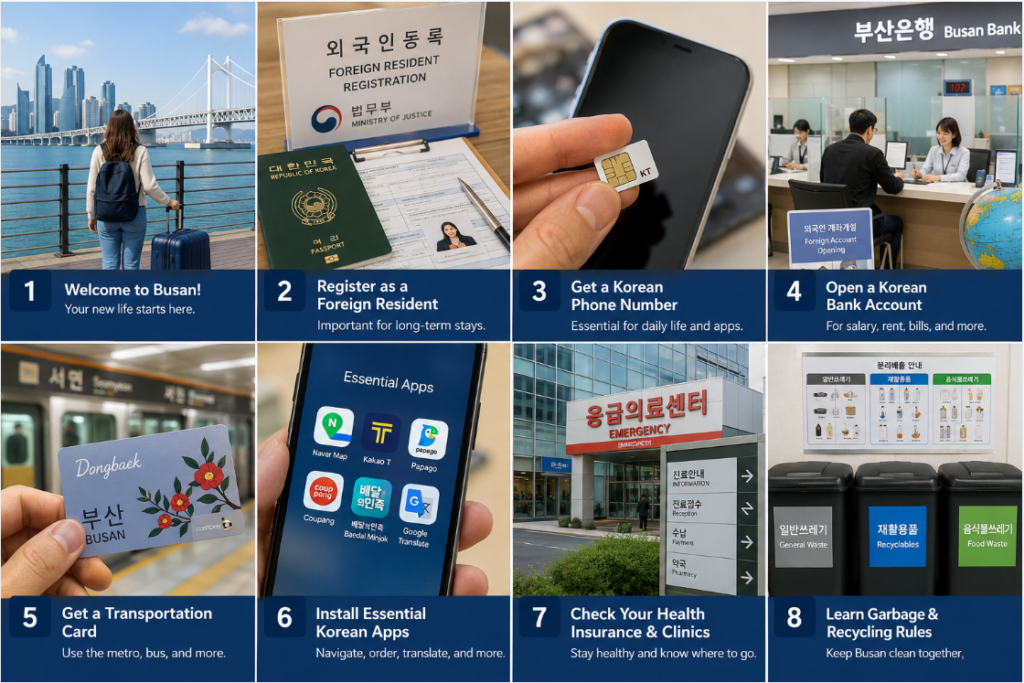
Your First 30 Days in Busan can feel surprisingly easy one moment and confusing the next.
Finding a convenience store, taking the subway, or ordering coffee is simple. But then you suddenly need a Korean phone number, a bank account, a residence card, a transportation card, or instructions for separating food waste—and the system may be completely different from what you are used to.
If you are moving to Busan for work, university, family, or a long-term stay, you do not need to solve everything on your first day.
The better approach is to do things in the right order.
During your First 30 Days in Busan, focus on building the basic systems that make everyday life easier: your legal registration, phone number, banking, transportation, healthcare, navigation, waste disposal, and local support network.
Here are the 10 things I would prioritize after moving to Busan.
Quick Answer: What Should You Do in Your First 30 Days in Busan?
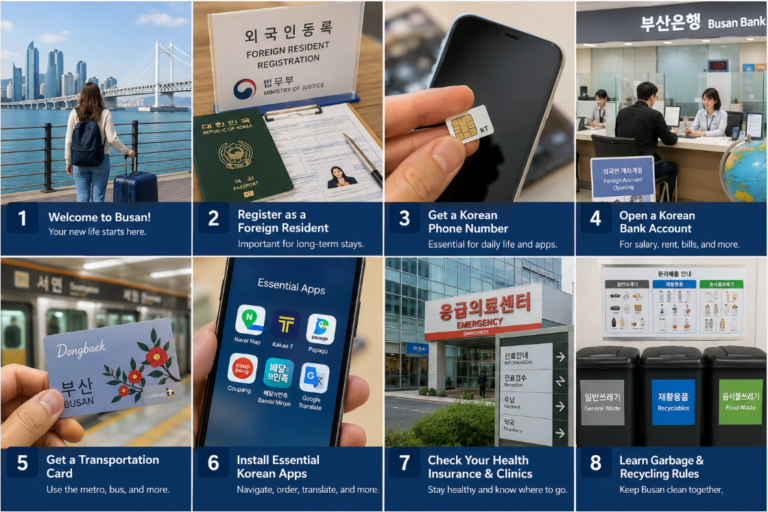
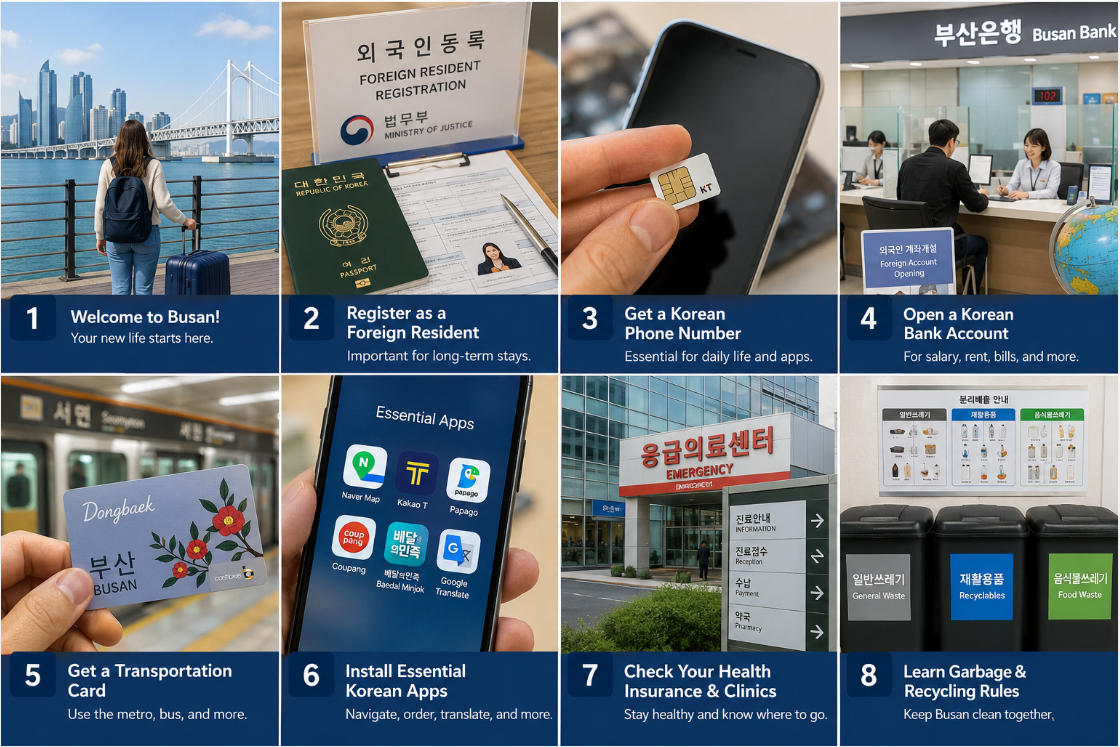
If you have just moved to Busan, start with these 10 tasks:
- Save your Korean address correctly
- Prepare your foreign resident registration
- Get a Korean phone number
- Open a Korean bank account
- Get a transportation card
- Install the apps you will actually use in Korea
- Understand your health insurance status
- Learn how garbage and recycling work
- Save the important foreigner support and emergency numbers
- Build a simple daily-life map around your neighborhood
You do not need to finish all 10 in the first week.
A practical order is:
Address → Phone → Residence registration → Bank → Transportation → Healthcare → Daily-life setup
Some steps depend on your visa, employment status, university, or whether your residence card has already been issued.
Table of Contents
- Save Your Korean Address
- Apply for Foreign Resident Registration
- Get a Korean Phone Number
- Open a Korean Bank Account
- Get a Busan Transportation Card
- Install Essential Korean Apps
- Check Your Health Insurance
- Learn Busan Garbage and Recycling Rules
- Save Important Support and Emergency Numbers
- Build Your Everyday Busan Routine
- What You Do Not Need to Rush
- First 30 Days in Busan Checklist
- Frequently Asked Questions
1. Save Your Korean Address Before You Do Anything Else
The first thing I recommend during your First 30 Days in Busan is surprisingly simple:
Save your home address exactly as it appears in Korean.
Do not rely only on an English translation.
Keep the Korean version somewhere easy to access on your phone.
For example:
부산광역시 수영구 ○○로 00
○○아파트 101동 1001호
You will use your address repeatedly when dealing with immigration, banks, mobile carriers, deliveries, online shopping, hospitals, and administrative services.
Also save:
- building name
- apartment or room number
- postal code
- landlord or management office number
- nearest subway station
- nearest major landmark
Local tip
Take a screenshot of your Korean address.
When a taxi driver, delivery person, bank employee, or receptionist cannot understand your pronunciation, showing the Korean address is often faster than trying to explain it.
This is one of those small things that makes living in Busan much easier.
2. Apply for Foreign Resident Registration Early
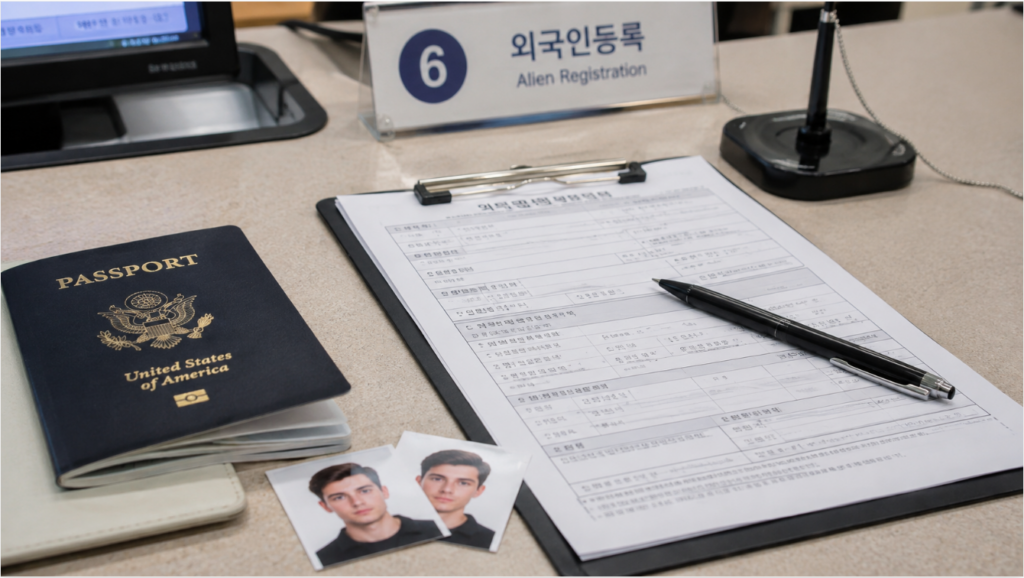
If you intend to stay in Korea for 90 days or more, foreign resident registration is one of the most important administrative tasks.
Korea Immigration Service states that foreigners intending to stay for 90 days or longer are generally required to apply for foreign resident registration within 90 days of entering Korea. Immigration visits for foreign resident registration normally require an online appointment.
Do not wait until Day 89.
Appointments can become inconvenient depending on the time of year, particularly around university semesters.
Typical documents can include:
- passport
- proof of residence
- passport-style photo
- documents required for your specific visa
The exact documents depend on your status of stay, so check HiKorea or Korea Immigration Service before your appointment.
Why this matters beyond immigration
Your residence card becomes important for many parts of normal Korean life.
It can make it easier to set up:
- a long-term mobile plan
- banking
- financial verification
- certain transportation benefits
- online services
- contracts requiring identity verification
So even though the legal deadline may be 90 days, I would treat registration as an early First 30 Days in Busan task, not something to postpone.
https://www.busan.go.kr/eng/call-center?utm_source=chatgpt.com
3. Get a Korean Phone Number
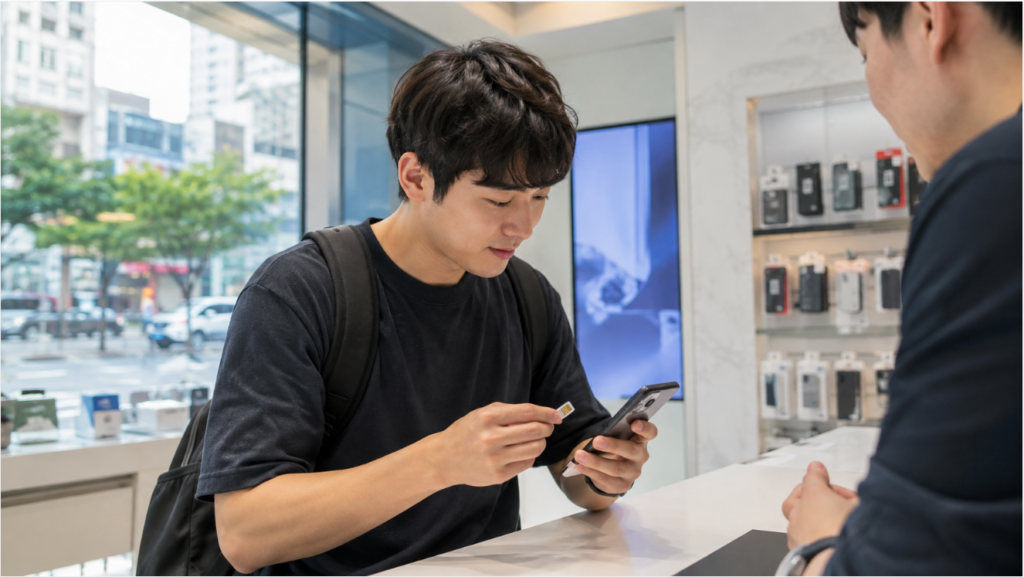
A Korean phone number quickly becomes more important than most newcomers expect.
You will use it for calls and messages, but it can also become part of your identity-verification process when using Korean digital services.
The good news is that you do not necessarily need to wait for your residence card to get connected.
KT says foreigners can subscribe using a passport, although passport-only subscriptions are limited to prepaid plans; SK Telecom also states that foreigners can sign up for prepaid service with a valid passport.
This gives you a practical two-step option:
When you first arrive:
Get a prepaid SIM or eSIM using your passport if necessary.
After receiving your residence card:
Compare long-term mobile plans and switch if a resident plan better fits your stay.
Do not choose a plan only because the airport counter is convenient.
If you plan to stay one or two years, compare:
- monthly data
- voice calls
- contract length
- cancellation conditions
- whether the number supports the services you need
- payment requirements
Requirements can differ by carrier and plan, so verify the current conditions before signing.
4. Open a Korean Bank Account
Once you are settling in, a Korean bank account makes everyday life much easier.
Busan Metropolitan City’s foreign resident guidance says a foreign national generally needs a passport and proof of foreign resident registration when opening a standard account.
A Korean bank account becomes useful for:
- salary deposits
- rent transfers
- utility payments
- mobile phone payments
- ATM withdrawals
- automatic payments
- Korean online services
Special note for international students in Busan
Busan, BNK Busan Bank, and the Busan Global City Foundation announced a program involving 16 dedicated branches for international students, including faster account-opening support using passports for eligible students.
This is a good example of why Busan-specific information matters.
A general “banking in Korea” article may tell you one thing, while a local program in Busan may give international students another option.
What I would bring
Even if someone tells you only one document is required, bring everything you have:
- passport
- residence card if issued
- Korean phone number
- Korean address
- university ID or employment documents if applicable
Bank procedures can depend on your status and the service you are requesting.
5. Get a Transportation Card and Learn Your Two Main Routes
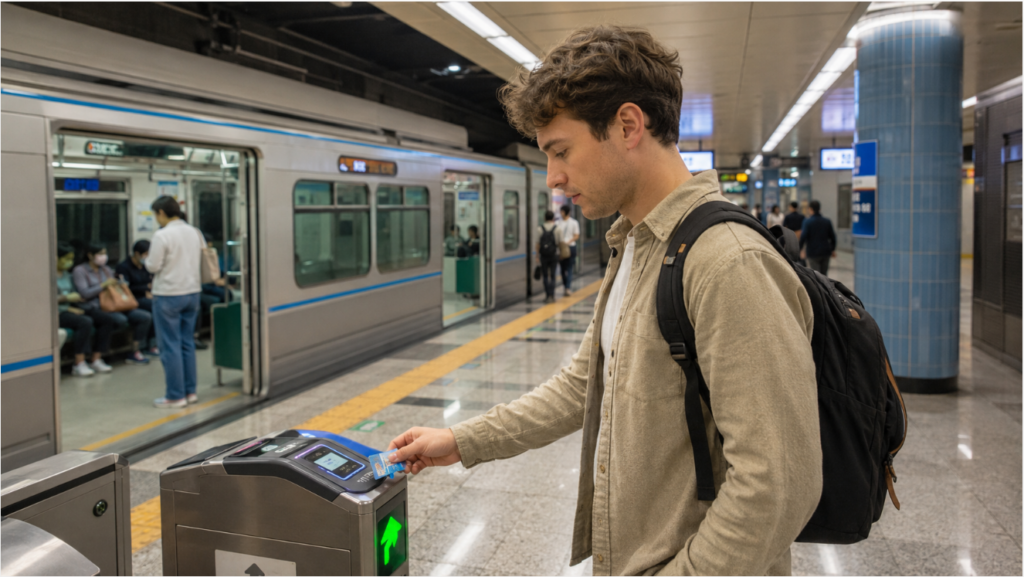
You do not need a car to start living in Busan.
One of the most useful things you can do during your First 30 Days in Busan is buy a prepaid transportation card and learn the routes you will use repeatedly.
Busan says prepaid transportation cards can be purchased at places including metro stations and convenience stores and can be recharged at metro stations, convenience stores, Busan Bank, and other designated locations.
Do not try to learn the whole Busan transportation system immediately.
Start with only two routes:
Route 1: Home → work or university
Route 2: Home → Seomyeon or another major transfer point you use frequently
Once these become familiar, the city feels much smaller.
After you receive your residence card: check the Prepaid Dongbaek Pass
Busan operates a Prepaid Dongbaek Pass specifically aimed in part at foreigners and people who have difficulty obtaining postpaid transportation cards.
As of August 2026, foreign residents with the required registration card can apply for the prepaid transportation card and enroll in the program. Under the current structure, eligible public-transport spending above KRW 45,000 per month can be partially refunded, up to the program’s maximum.
Because transport policies can change, check the current conditions before applying.
https://www.busan.go.kr/eng/bscard
6. Install the Apps You Will Actually Use in Busan
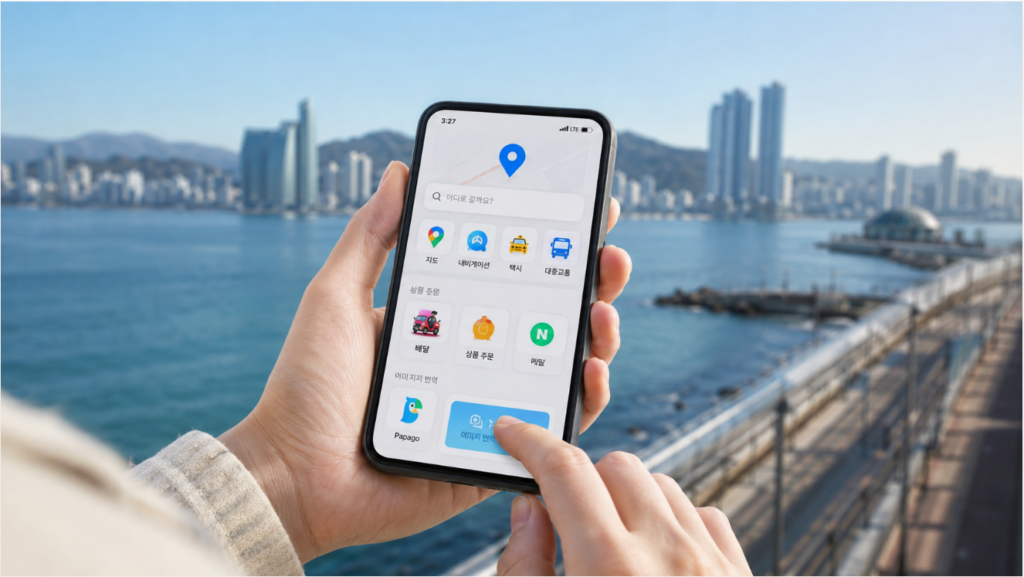
You do not need 20 Korean apps on your first day.
Start with a few that solve everyday problems.
NAVER Map
NAVER Map currently supports Korean, English, Japanese, and Chinese maps, as well as English navigation and public-transport directions.
Use it to save:
- home
- office or university
- hospital
- supermarket
- favorite restaurants
- subway stations
Kakao T
Kakao T allows users to request taxis in Korea and its current app supports English.
Even if you usually take the subway, install a taxi app before you actually need one.
The worst time to learn how to call a taxi is at midnight in an unfamiliar neighborhood.
Papago
Papago provides text, voice, image, and conversation translation across multiple languages.
Image translation is particularly useful for:
- utility notices
- apartment notices
- menus
- medicine instructions
- letters
- administrative documents
Local tip
Do not translate everything.
Start recognizing a few words you will see constantly:
- 입구 — entrance
- 출구 — exit
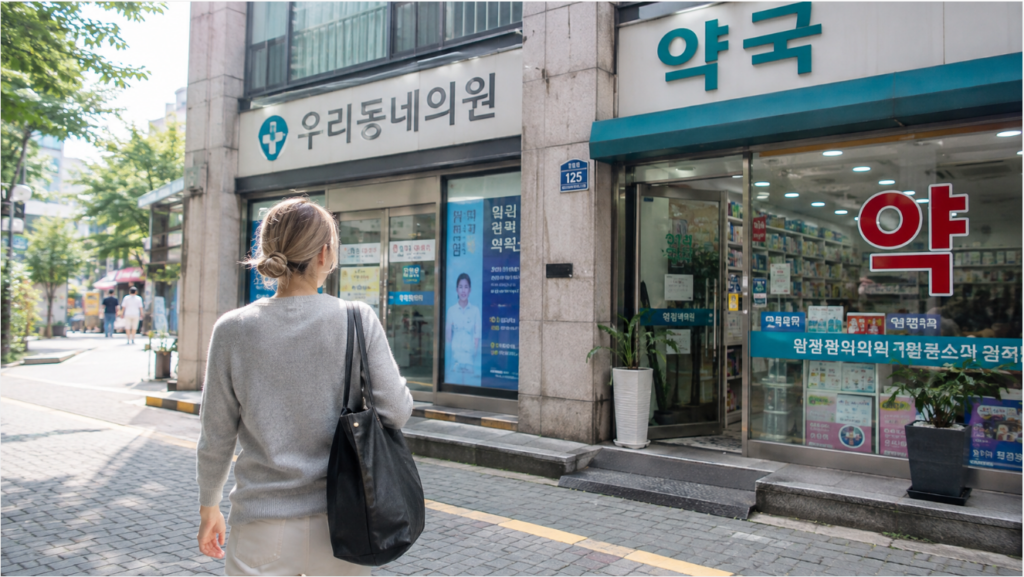
- 약국 — pharmacy
- 병원 — hospital
- 월세 — monthly rent
- 관리비 — management fee
- 일반쓰레기 — general waste
- 음식물 — food waste
A few practical Korean words save more time than trying to study an entire textbook during your first month.
7. Check Your National Health Insurance Status
Do not assume every foreign resident follows the same health-insurance timeline.
The National Health Insurance Service distinguishes between foreign employees and self-employed foreign residents.
Foreigners working at an insured workplace are generally enrolled as employee-insured persons, while eligible self-employed foreigners who have stayed in Korea for more than six months are subject to mandatory enrollment under the applicable rules.
Your situation may therefore depend on:
- employment
- visa status
- residence period
- student status
- family status
If you are unsure, check directly with NHIS rather than relying on another foreigner’s experience.
NHIS also states that insured foreigners receive the same national health-insurance coverage framework as Korean citizens.
What I recommend doing in your first month
Find and save:
- one nearby internal-medicine clinic
- one pharmacy
- one larger hospital
- the closest emergency room
Do this while you are healthy.
You do not want your first search for a hospital to happen while you have a high fever at 11 p.m.
https://www.nhis.or.kr/english/wbheaa02900m01.do
8. Learn Busan’s Garbage and Recycling Rules
This is one of the least glamorous parts of the First 30 Days in Busan, but it is something foreigners often become confused about immediately.
Busan separates household waste and recyclable materials, and disposal arrangements can differ according to the district and building.
Your apartment may have:
- a designated recycling area
- specific disposal days
- separate food-waste equipment
- building-specific instructions
The easiest solution is not to memorize every Korean recycling rule on Day 1.
Ask your:
- landlord
- building manager
- management office
- neighbor
this simple question:
“When and where do I throw away trash?”
Then take a photo of the instructions.
Important local habit
Do not assume that a plastic container automatically belongs with plastic recycling.
Food contamination, material type, labels, and local collection systems can affect disposal.
If you are unsure, check your district’s current guidance rather than guessing.
9. Save These Numbers Before You Need Them
Most people do not think about emergency or support numbers until there is a problem.
Save them during your First 30 Days in Busan.
Busan Foreign Resident Call Center
1600-0051
Busan operates a multilingual call center for foreign residents covering everyday life, immigration, employment, interpretation, and related support. The current service operates Sunday through Friday from 9 a.m. to 6 p.m., with some service details varying by day and language.
This is one number I would genuinely recommend every long-term foreign resident in Busan save.
Immigration Contact Center
1345
Korea Immigration Service provides immigration guidance through the Immigration Contact Center.
Emergency
119 — fire and rescue
112 — police
Busan’s official foreign resident information lists these emergency services.
Save the numbers now.
You probably will not need them—but that is exactly why it is easy to forget them.
10. Build Your Own 15-Minute Busan
The last task has nothing to do with paperwork.
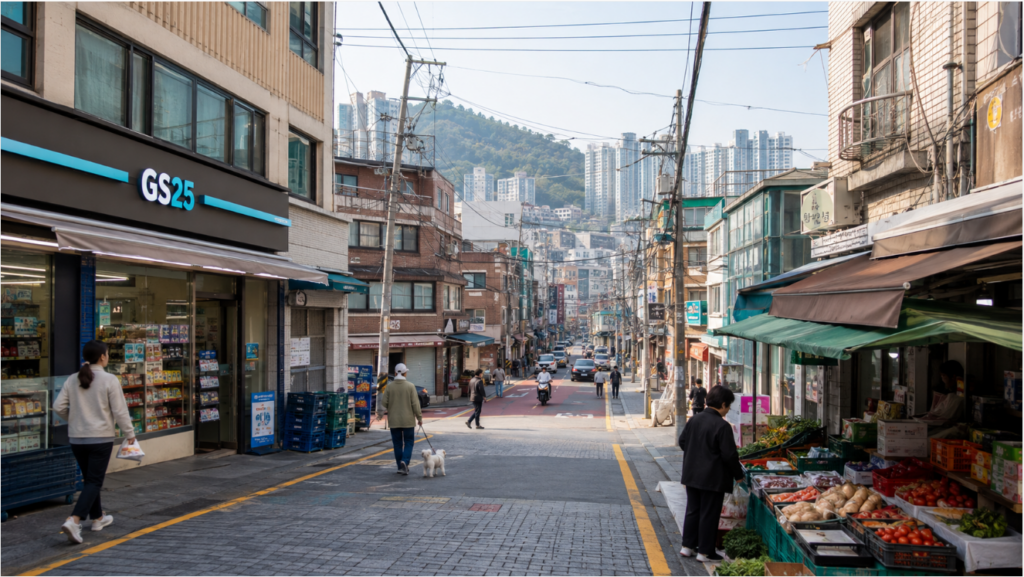
During your First 30 Days in Busan, learn the small area immediately around your home.
Within a 10–15 minute walk, find:
- supermarket
- convenience store
- pharmacy
- clinic
- subway or bus stop
- ATM
- café
- laundry or dry cleaner if needed
- recycling area
- police box or public office
- one inexpensive restaurant you can visit without thinking
This is when a city stops feeling temporary.
You no longer need to search every time you need toothpaste, medicine, dinner, or an ATM.
A local way to settle in
I would also recommend walking around your neighborhood without a destination at least once.
Busan neighborhoods often change quickly within a few streets.
A major road may feel busy and commercial, while five minutes uphill or inland you may find:
- traditional markets
- small restaurants
- parks
- walking paths
- cheaper cafés
- residential streets
The fastest way to understand Busan is not to see more tourist attractions.
It is to understand the small part of the city you use every day.
What You Do Not Need to Rush in Your First 30 Days in Busan
Not everything needs to happen immediately.
You probably do not need to rush into:
- buying a car
- signing the cheapest long-term phone contract
- getting a Korean credit card
- changing to a large-deposit housing contract
- learning fluent Korean
- visiting every famous place in Busan
Your first month should be about building functional independence.
Can you:
- get home?
- communicate?
- pay?
- travel?
- visit a doctor?
- dispose of trash?
- get help?
If the answer becomes yes, you are settling in.
First 30 Days in Busan Checklist
Use this as a simple checklist:
- Save my full Korean address
- Make my immigration appointment if required
- Get a Korean phone number
- Open a Korean bank account
- Buy and recharge a transportation card
- Check whether I can use Dongbaek Pass
- Install NAVER Map, Kakao T, and a translation app
- Confirm my health-insurance status
- Find a clinic and pharmacy near home
- Learn my building’s garbage schedule
- Save 1600-0051, 1345, 112, and 119
- Learn the area within 15 minutes of my home
You do not need to complete this list in three days.
The goal is to finish most of it during your First 30 Days in Busan.
Frequently Asked Questions
What should I do first after moving to Busan?
Start with your Korean address, phone connection, and immigration requirements. If you will stay 90 days or longer and are subject to foreign resident registration, Korea Immigration Service requires registration within 90 days of entry.
Can I get a Korean SIM card before receiving my residence card?
Yes, prepaid options are available from major carriers using a valid passport. KT and SK Telecom both currently provide passport-based prepaid options for foreigners, although conditions and duration limits apply.
Can I open a Korean bank account immediately?
Standard Busan guidance says foreign nationals generally need a passport and proof of foreign resident registration for a regular bank account. However, certain international students in Busan may have additional options through designated BNK Busan Bank branches.
Can I live in Busan without a car?
For many residents, yes. Busan has metro, bus, light-rail, and rail connections, and prepaid transportation cards are readily available through stations and convenience stores.
Where you live matters, however. A home near a useful subway line can make a major difference to daily life.
Is there English help for foreigners living in Busan?
Yes. Busan’s Foreign Resident Call Center at 1600-0051 provides multilingual assistance for everyday living and administrative issues.
Final Thoughts
Your First 30 Days in Busan should not be about trying to understand all of Korea.
Focus on the systems you need every day.
Get your phone working. Know your address. Complete the immigration steps that apply to you. Set up banking and transportation. Understand your healthcare status. Learn how your building handles trash. Save the numbers you may need when something goes wrong.
Then start learning your neighborhood.
Once you know where to buy food, catch the subway, see a doctor, withdraw money, and ask for help, Busan begins to feel much less foreign.
You do not need to become an expert on Korea in one month.
You just need to make everyday life work.
And that is the real goal of your First 30 Days in Busan.
https://easykorealife.com/wp-admin
About the Author